By the StoryCoach team · Last updated
AI Feedback on Your Story: Know What Lands Before You Tell It
Want AI to rate your story and explain what to fix? StoryCoach gives you AI story feedback from a story coach AI built for personal stories you tell out loud — not just fiction on the page. Paste a draft or start from a memory. StoryCoach points out what is working, what is unclear and what to change, then helps you revise it into a story you can tell with confidence.
Chatting and critique are free. Free accounts include 3 AI credits for AI-written drafts and revisions.
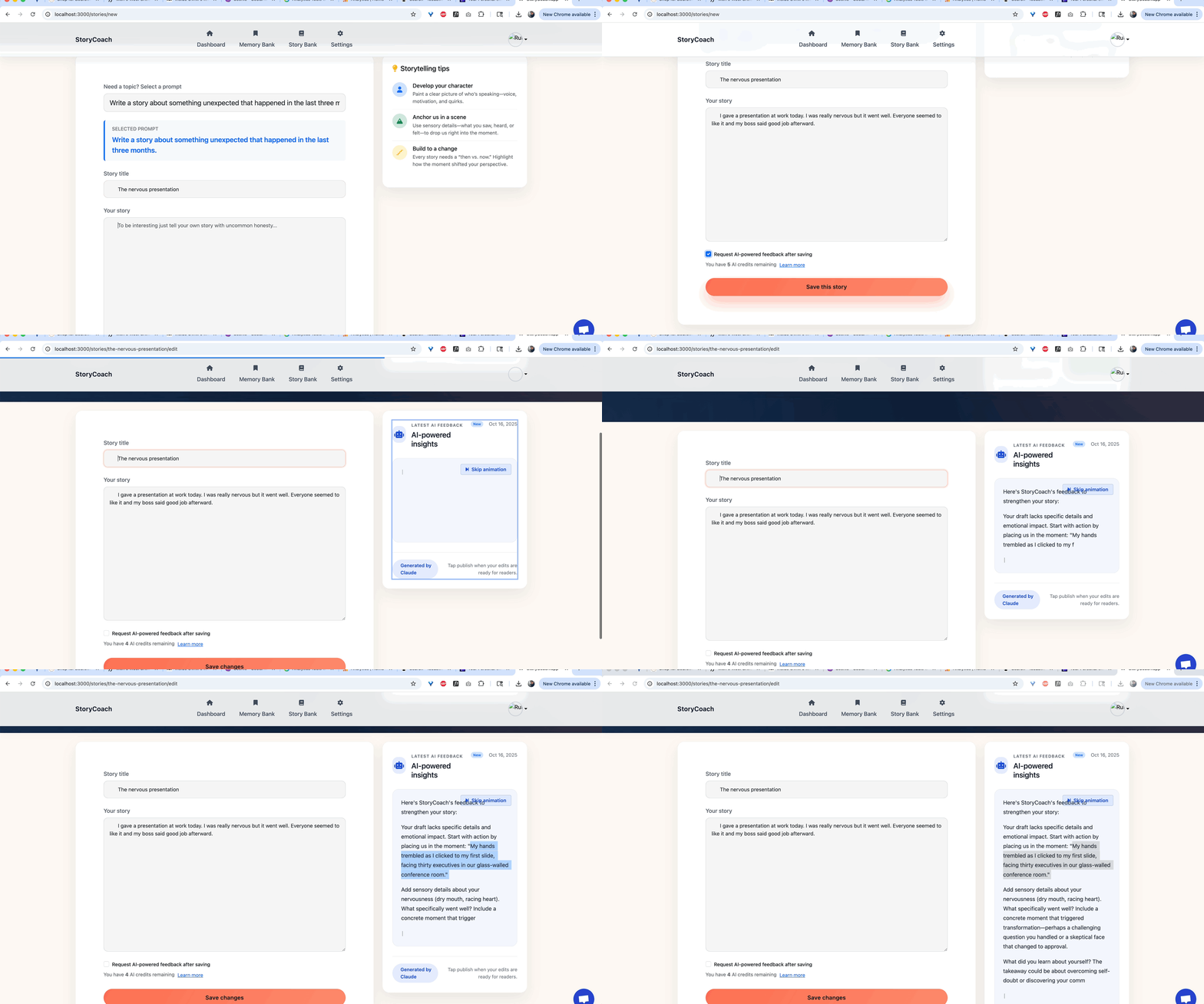
AI story feedback for stories you tell, not just stories you write
Most AI feedback tools are built for novels, chapters and manuscripts. StoryCoach is built for the personal stories you tell out loud: a talk, toast, pitch, podcast interview, work presentation, family story or story at an open-mic night. Bring the moment as it happened; StoryCoach helps you find the story inside it and shape it for a listener.
What is AI story feedback?
In StoryCoach, AI story feedback is a conversation with an AI writing partner. You bring a memory or a draft. The partner asks about the moment, critiques the draft using the CART framework and the PAST framework — structure, emotional arc, scene detail and takeaway — and, when you ask, writes revisions you can edit, undo and keep.
How StoryCoach AI feedback works
Write or import your story
Start from a memory, a prompt, or paste an existing draft into a Writing session.
Talk it through with your partner
Ask for critique on clarity, emotional arc and scene detail. Chatting and critique are free.
Revise with confidence
Get two drafts at a time. Edit by hand or by asking for changes, undo anything, and keep the version you like. Each AI-written draft or rewrite uses one credit.
No draft yet? Capture one story-worthy moment with Homework for Life, then turn it into a draft.
What the feedback checks
Every session is meant to leave you with specific next edits, not just a vague opinion of the draft.
- Strengths first — What is already working and which moments stand out.
- Structure and clarity — Whether the listener can follow the moment, the turn and the takeaway.
- Emotional arc — Where the feeling rises, drops or needs a clearer change.
- Scene detail (PAST) — Place, actions, speech and thoughts, so a summary becomes a scene.
- Concrete revision pathways — Specific changes to try next, in a useful order.
- Delivery suggestions — Notes for telling the story live or recording it.
See AI story feedback on a sample story
Sample story and sample feedback, written to show the kind of notes StoryCoach gives. It is illustrative, not a customer story.
The draft
When I was twelve, I accidentally locked my little brother out of the house during a thunderstorm. I felt bad, so I made him hot chocolate when he got back inside. That day I learned that mistakes can be fixed.
What StoryCoach would flag
- Hook: Start at the door during the storm. That is the moment of tension; the background can come later.
- Scene detail: Add what you can see, hear, say and think — the rain, your brother’s voice from the porch, and the second you froze at the handle.
- Emotional arc: Let the guilt land before the repair. The hot chocolate works better after the listener feels the mistake.
- Takeaway: End on the repair, not a general lesson. Show what changed between you and your brother.
A stronger opening
The rain was hammering the front door when I heard my brother shout my name from the porch. I had locked him out. For one long second, I just stared at the handle, certain he would never forgive me.
Inside StoryCoach, you could ask for a full revised draft, edit it by hand or by prompt, undo any change, and keep the version you like.
AI feedback vs a human storytelling coach
They solve different parts of the problem.
- Use AI feedback when you need a fast first pass, are drafting alone, or want feedback on structure, clarity and scene detail before rehearsal. It is available whenever you sit down to write.
- Use a human coach or audience when you need feedback on your voice, timing, body language and how a room reacts.
- Best sequence: Strengthen the draft in StoryCoach, practise it out loud, then get human feedback on the delivery.
You stay in control of the draft
StoryCoach does not change or publish your story on its own. It critiques when you ask, writes or rewrites drafts when you ask, and leaves the decisions with you: edit by hand, ask for another change, undo, or keep the version you prefer.
How your story text is handled
When you request AI feedback, StoryCoach sends only the text needed for that feature to its AI providers, OpenAI and Anthropic. It does not send your name, email address or other account details with that text. Avoid putting sensitive personal details in a story you do not want processed by an AI provider. Read the Privacy Policy for details.
Credits and one-time plans
Chatting and critique are free.
Free accounts include 3 AI credits. Each time the AI writes or rewrites drafts for you, it uses one credit. Hand edits, undo and redo cost nothing. Credits never expire.
You can earn more credits by completing exercises such as Crash & Burn, Memory Prompts and Three Random Words.
- Story Starter — $1.99 one-time — adds 5 AI credits.
- Story Builder — $4.99 one-time — adds 15 AI credits.
- Story Master — $9.99 one-time — adds 25 AI credits.
No subscription. Plans are one-time purchases.
Frequently asked questions
Start with the story you need to tell
Paste a draft or begin with one remembered moment. Get the feedback before the room hears it. When the story is ready, keep the version you like in your Story Bank and use it again when the right audience appears.
Free to start. Includes 3 AI credits.